
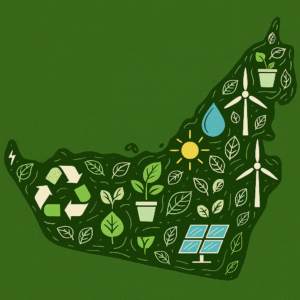
How Does the UAE Contribute to Sustainability?
The United Arab Emirates (UAE) has evolved from a desert nation reliant on fossil fuels into a global force for sustainability and environmental progress. While
EPD UAE, as an expert team operating under ERKE, offers environmental product declaration (EPD) consultancy services in United Arab Emirates. Our team, having successfully completed many projects in various countries, is by your side for your sustainability goals.
EPD UAE is an entity offering environmental product declaration (EPD) consultancy services, managed by ERKE’s expert team. Our team, operating within ERKE, guides companies through all the processes needed to document the environmental impacts of their products in a transparent and scientific manner. To date, the EPD UAE team has delivered dozens of successful projects in many countries and serves as a reliable partner for companies looking to meet global sustainability standards. Our mission is to contribute to a more sustainable world by supporting companies in enhancing their environmental performance.
EPD (Environmental Product Declaration) is a document prepared in accordance with the ISO 14025 standard that scientifically and objectively evaluates the environmental impacts of a product throughout its life cycle. The aim of EPD is to transparently present the environmental performance of products, enable comparisons between different products, and promote sustainable production and consumption processes.
The first step in the EPD process is to gather the necessary data to accurately analyze the environmental impacts of the product throughout its life cycle. During this phase, information is compiled from all stages, such as energy consumption in the production process, raw material usage, waste management, and logistics. It is crucial that the data is accurate, complete, and consistent.
The collected data is modeled using various software and databases to prepare a Life Cycle Assessment (LCA) report. This analysis reveals the environmental impacts of the product throughout all processes, from “raw material to end user” and even “post-use disposal.” The LCA report, prepared in accordance with ISO 14040/44 and EN 15804 standards, forms the basis of the EPD.
The process of preparing the EPD begins with converting the LCA results—which evaluate the product’s environmental impacts—into a format that complies with ISO 14025 and EN 15804 standards. The LCA analysis details the environmental impacts at different stages, from production to post-use disposal. During the preparation phase, a company-specific EPD document is designed following the rules and guidelines set by the EPD program operators. The environmental data is enriched with graphics and tables to create a transparent, clear, and technically as well as visually impeccable document.
The prepared LCA report and EPD document are reviewed by an independent, accredited third-party verifier. In this review, the accuracy of the information and its compliance with international standards are checked. Once the verification process is complete, the EPD document is officially approved.
After the verification stage, the EPD is published by an international operator company selected by the manufacturer.
The publication of EPD (Environmental Product Declaration) documents is carried out by independent EPD program operators that work in accordance with international standards. These organizations manage the processes of verifying, registering, and publishing EPD documents on international platforms. Below are some of the prominent EPD publishing organizations in the world.
An EPD document consists of the following key components:
An EPD can be prepared for a wide range of products. It is generally preferred for the following products:
In short, an EPD can be prepared for any product for which an assessment of its environmental impacts is desired.
An EPD is based on the results of an LCA analysis. Life Cycle Assessment (LCA) examines the environmental impacts of a product throughout its entire life cycle—from raw material extraction to waste disposal. This analysis forms the foundation of the EPD and determines the product’s environmental impacts such as its carbon footprint, energy usage, and water consumption. While the LCA ensures the scientific accuracy and reliability of the data, the EPD presents these results in a standardized format for public disclosure.
For these reasons, an EPD is a critical tool for achieving environmental sustainability goals and differentiating in the marketplace.
EPD UAE, operating under ERKE, offers environmental product declaration (EPD) consultancy services. By analyzing the environmental impacts of products throughout their life cycle, we prepare EPD documents in accordance with international standards. We provide services such as life cycle analysis (LCA), carbon footprint calculation, and environmental data verification to support companies’ sustainability goals. Our expert team, which has successfully completed numerous projects from Saudi Arabia to Australia, helps companies gain a competitive edge in global markets and document their environmental responsibilities. EPD UAE leads the way toward a sustainable future.

The United Arab Emirates (UAE) has evolved from a desert nation reliant on fossil fuels into a global force for sustainability and environmental progress. While


Over the past two decades, the United Arab Emirates (UAE) has undergone a dramatic transformation from an oil-driven economy to a global advocate of sustainability.

The United Arab Emirates (UAE) has become a regional and global leader in sustainability by embedding environmental responsibility into its national development agenda. Rather than

Contrary to common misconceptions, UAE citizens known as Emiratis are actively involved in shaping the nation’s workforce, especially in areas that are central to national

The United Arab Emirates (UAE) has rapidly emerged as one of the leading nations in sustainable development. What sets the UAE apart is its ability
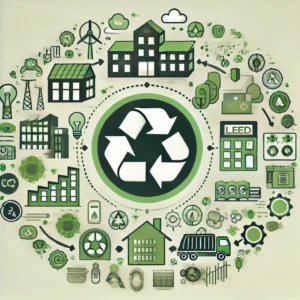
In today’s environmentally conscious construction landscape, understanding the environmental impact of materials and products has become crucial. Stakeholders such as architects, engineers, developers, and manufacturers
WhatsApp us